By Lindsay Powers | Nutritional Therapist & Health Writer, Naturally Healthy News
Published: October 2026 | Last reviewed: October 2026
Every October, millions of us buy a pumpkin, carve a face into it, and throw it away the day after Halloween. What almost nobody does is eat it, which is a shame, because underneath the spooky face is one of the more nutritious vegetables in the supermarket.
This piece explores both sides of that pumpkin: the surprisingly old story behind why we carve them at all, and the real nutrition inside the one on your doorstep right now.
Quick Summary
- More than a billion pounds of pumpkin go to landfill in the US alone every Halloween, and the same pattern shows up in the UK and beyond.
- One cup of pumpkin has more potassium than a banana, for just 50 calories.
- That same cup covers your entire day’s vitamin A needs, thanks to its beta-carotene.
- Unlike vitamin A supplements, you can’t overdose on beta-carotene from food.
- The jack-o’-lantern tradition started with carved turnips in Ireland, not pumpkins at all.
A Tradition Older Than America
The jack-o’-lantern didn’t start with pumpkins at all. Irish and Scottish folklore tells of “Stingy Jack,” who tricked the Devil so many times that when he died, neither heaven nor hell would take him, leaving him to wander the earth for eternity, lighting his way with a burning coal placed inside a hollowed-out turnip [1]. People began carving scary faces into turnips and beets and setting them in windows to frighten Jack and other wandering spirits away.
When Irish and Scottish immigrants brought the tradition to America in the 19th century, they found a vegetable that was far more abundant and much easier to carve than a turnip [1]. The pumpkin took over, and the eating half of the tradition quietly got lost along the way.
What’s Actually Inside a Pumpkin?
A single cup of cooked pumpkin contains just 50 calories, 3 grams of fibre, and 564mg of potassium [2]. This is more potassium than a medium banana, which has around 422mg [3]. It’s also an outstanding source of vitamin A, with that same cup providing 245% of the recommended daily amount, thanks to beta-carotene, which gives it its orange colour [2].
For a vegetable best known for being carved rather than cooked, that’s an impressive nutritional profile hiding in plain sight.
What Does Vitamin A Actually Do for You?
Vitamin A plays two well-established roles. For vision, it’s needed to make rhodopsin, the light-sensitive pigment in the retina that lets your eyes adjust in dim light [6]. This is why a deficiency causes night blindness and why vitamin A carries an EFSA-authorised claim for the maintenance of normal vision [4].
For immunity, it helps maintain the mucous membranes lining your respiratory, digestive and urinary tract, one of the body’s first physical barriers against infection [10], alongside its EFSA-authorised role in the normal function of the immune system [5].
A Genuine Ally for Blood Pressure
Potassium works against sodium to help relax blood vessel walls and support healthy blood pressure, a well-established relationship backed by decades of nutrition research [9]. At 564mg per cup, pumpkin is a useful everyday source, alongside other potassium-rich foods like bananas, leafy greens and beans.
The Safety Upside of Getting Vitamin A From Food
Unlike vitamin A supplements, which use preformed vitamin A (retinol) and can build up to toxic levels in the liver at high doses, you cannot overdose on beta-carotene from food [6]. Eat too much, and the worst that happens is carotenodermia, a harmless orange tinge to the skin that fades once you cut back. Pumpkin is one of the few truly worry-free ways to get a serious amount of vitamin A.
Don’t Throw Away the Seeds
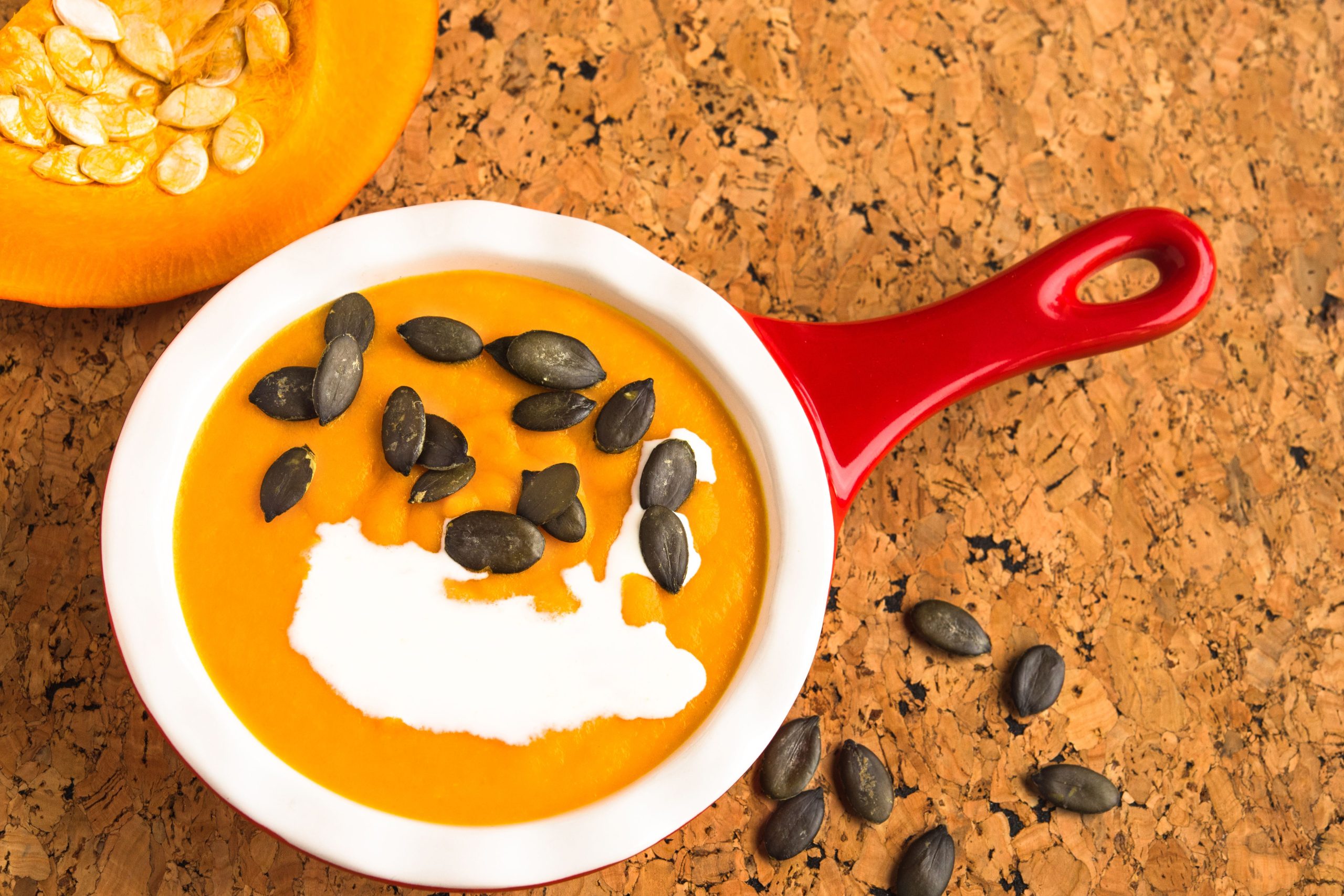
While you’re rescuing the flesh from the bin, save the seeds too. They’re just as useful in their own right. Rinse, dry, and roast them with a little salt for a tasty snack.
Getting More From This Year’s Pumpkin
- Scoop out the flesh before or after carving and roast it in cubes with olive oil for a simple side dish.
- Blend roasted pumpkin into a soup with stock, garlic and a little ginger.
- Freeze leftover cooked pumpkin in portions, as it keeps well for months and drops straight into soups, stews and curries.
- Rinse, dry and roast the seeds separately instead of composting them with the flesh, as they make a great snack.
- If your pumpkin has been sitting outside and looks past its best, compost it rather than eating it.
Frequently Asked Questions
Is the pumpkin I carved for Halloween actually safe to eat?
Yes, as long as it hasn’t started to rot or been sitting outside for weeks. A freshly carved pumpkin’s flesh is the same vegetable as the ones sold pre-cut for cooking. Just check it over the same way you would any other vegetable before using it.
Is pumpkin high in sugar or carbs?
No, it’s low in both. A cup of cooked pumpkin has around 12g of carbohydrate and just 50 calories [2], making it one of the lower-calorie, lower-carb winter vegetables available.
Does pumpkin really have more potassium than a banana?
Yes, cup for cup. A cup of cooked pumpkin has around 564mg of potassium [2], compared with roughly 422mg in a medium banana [3].
Why do so many pumpkins go to waste at Halloween?
Mostly because carving culture has drifted away from the eating half of the tradition, and that pattern shows up worldwide. More than a billion pounds of pumpkin end up in US landfills every year after Halloween [7], and in the UK an estimated 18,000 tonnes are wasted with only around 30% of the flesh actually eaten [8], despite it being a nutritious, low-calorie vegetable.
Final Thoughts
The jack-o’-lantern tradition has always been about more than decoration. It’s just that the eating half got left behind somewhere between Ireland and the supermarket aisle. This Halloween, the flesh you’re scooping out to carve is one of the better vegetables in the shop. It’s low in calories, rich in potassium and vitamin A.
Save the flesh, save the seeds, and let this year’s jack-o’-lantern earn its keep before it goes in the bin.
References
[1] History.com: How Jack O’Lanterns Originated in Irish Myth. https://www.history.com/articles/history-of-the-jack-o-lantern-irish-origins
[2] Mayo Clinic Health System: Pumpkin: Loaded With Good Nutrients. https://www.mayoclinichealthsystem.org/hometown-health/speaking-of-health/pumpkin-loaded-with-scary-good-nutrients
[3] Harvard T.H. Chan School of Public Health: Bananas: The Nutrition Source. https://nutritionsource.hsph.harvard.edu/food-features/bananas/
[4] EFSA Journal, 2010: Scientific Opinion on Vitamin A and Maintenance of Normal Vision. https://efsa.onlinelibrary.wiley.com/doi/10.2903/j.efsa.2010.1754
[5] EFSA Journal, 2013: Scientific Opinion on Vitamin A and Normal Function of the Immune System. https://efsa.onlinelibrary.wiley.com/doi/10.2903/j.efsa.2013.3334
[6] NIH Office of Dietary Supplements: Vitamin A: Health Professional Fact Sheet. https://ods.od.nih.gov/factsheets/VitaminA-HealthProfessional/
[7] LAist, citing the US Department of Energy: Halloween Pumpkin Waste Is a Methane Problem, But Chefs and Farmers Have Solutions. https://laist.com/news/climate-environment/halloween-pumpkin-waste-methane-problem-solutions
[8] Worcestershire County Council, citing Hubbub UK: Halloween Horror: 18,000 Tonnes of Pumpkins Wasted Every Year. https://www.worcestershire.gov.uk/news/halloween-horror-18000-tonnes-pumpkins-wasted-every-year
[9] American Heart Association: How Potassium Can Help Control High Blood Pressure. https://www.heart.org/en/health-topics/high-blood-pressure/changes-you-can-make-to-manage-high-blood-pressure/how-potassium-can-help-control-high-blood-pressure
Our Recommendations
Naturally Healthy News is part of the Good Health Naturally family of brands.
If you’d rather get pumpkin seed’s benefits in supplement form than roast a fresh batch, Pumpkin Seed Extract With Soy Isoflavones is available.
Disclaimer: The information in this article is intended for general informational purposes only and does not constitute medical advice. It is not a substitute for professional medical advice, diagnosis, or treatment. Always seek the advice of your GP or a qualified healthcare provider with any questions you may have regarding a medical condition. Never disregard professional medical advice or delay seeking it because of something you have read here.