
By Catherine Gorman | Nutritional Therapist & Health Writer, Naturally Healthy News
Published: July 2026 | Last reviewed: July 2026
Poor sleep is far more than a nightly inconvenience. It is increasingly recognised as a public health issue, with links to mood, memory and long-term brain health. Chronic sleep disruption has been associated with a higher risk of neurodegenerative conditions such as Alzheimer’s and Parkinson’s disease, which makes sleep quality especially important as we age. [1] As researchers search for safe, natural ways to support sleep, growing attention is turning to the gut microbiome and its powerful influence on the brain.
A recent UK trial suggests that saffron and sleep may be more closely connected than most people realise, with the spice appearing to improve sleep quality partly by reshaping the balance of bacteria in the gut. Here is what the research found, and what it might mean for anyone hoping to support their sleep naturally. [4]
Quick Summary
- Saffron improved sleep quality in a UK pilot trial
- Gut bacteria produce neurotransmitters that influence sleep via the gut-brain axis
- Saffron increased bacteria linked to short-chain fatty acid production
- Poor sleep in later life is linked to a higher risk of cognitive decline
- Findings are promising but come from a small pilot study, so larger trials are needed
Sleep, Ageing and Cognitive Health
Ageing often brings noticeable changes to sleep patterns. Many older adults experience shorter sleep duration and lighter, more fragmented sleep with frequent nighttime awakenings. Sleep is far from a passive state. At various points in the night, the brain is almost as active as when we are fully awake, carrying out essential maintenance across the body, replenishing energy stores and clearing metabolic waste.
Sleep is also an important time for memory consolidation and emotional regulation. When sleep is consistently disrupted, these processes are impaired, which may accelerate cognitive decline and reduce overall quality of life. [1] This has led researchers to look more closely at safe, natural ways to support healthy sleep in later life.
The Gut-Brain Axis and Sleep Regulation
Scientific research has revealed that the gut and brain are in constant communication through what is known as the gut-brain axis. The trillions of bacteria living in the digestive system produce neurotransmitters and signalling molecules. These include serotonin, GABA and short-chain fatty acids, all of which can influence sleep, mood and cognition. [2]
Poor sleep can disrupt the balance of gut bacteria, and people with insomnia frequently show altered gut microbiomes. This bidirectional relationship has prompted researchers to ask whether reshaping the gut microbiome, through diet or specific compounds, might help improve sleep in return.
Diet and the Gut Microbiome: Where Saffron Comes In
Diet is one of the most powerful tools for shaping the gut microbiome. Certain foods contain compounds that nourish beneficial bacteria and can influence the brain chemistry involved in sleep regulation. [3]
One such food is saffron, a spice used for centuries in traditional medicine. Earlier research has suggested that saffron may improve sleep quality and reduce the time it takes to fall asleep, with some studies also showing that saffron can positively alter the composition of the gut microbiome.. [3] Until recently, no one had explored whether these two effects were connected.
Inside the Gut-Sleep-Brain Axis Trial
A pilot study conducted by researchers at the University of East Anglia set out to investigate exactly that question. The randomised, double-blind, placebo-controlled trial took place in Norwich and involved 52 adults aged between 55 and 85 who reported ongoing sleep complaints. Participants were generally healthy and in good cognitive health. Certain people were excluded if they had conditions or lifestyle factors likely to strongly affect sleep or gut health. [4]
Over four weeks, participants were randomly assigned to take either 30mg of a standardised saffron extract or a placebo. These were delivered as orange-flavoured gummies, taken 30 minutes before bedtime, and were designed to look and taste identical. Researchers assessed sleep using validated questionnaires alongside an at-home EEG sleep-tracking headband. They also analysed gut microbiota from stool samples collected from a subgroup of 26 participants before and after the intervention. [4]
How Saffron Affected Sleep Quality
In just four weeks, saffron supplementation produced measurable improvements, with participants taking saffron reporting significantly better sleep quality than those taking the placebo. Overall sleep quality, measured using the Pittsburgh Sleep Quality Index, improved by around 21% in the saffron group, while scores in the placebo group worsened by close to 9% over the same period. Sleep efficiency also improved in the saffron group. [4]
Objective data told a similar story. Researchers collected almost 600 full nights of EEG data in total, and people taking saffron fell asleep faster, reached a state of persistent sleep more quickly and spent less time awake during the night than those taking the placebo. Together, the subjective and objective findings suggest saffron helped participants both fall asleep and stay asleep. [4]
Saffron and the Gut Microbiome
The study also revealed meaningful shifts in gut bacteria. Saffron supplementation increased the abundance of several bacterial groups linked to gut and brain health, including Faecalibacterium, Roseburia and Prevotella. At the same time, reducing bacteria such as Dialister that have been associated with poorer sleep outcomes in other research. [4]
While overall microbial diversity did not change, the balance between the two dominant bacterial groups in the gut, Firmicutes and Bacteroidetes, shifted in a favourable direction. Many of the bacteria that increased are known producers of short-chain fatty acids such as butyrate. These help regulate inflammation, support brain health and influence the sleep-wake cycle. [4]
What This Might Mean for Natural Sleep Support
The researchers suggest that saffron may improve sleep partly by encouraging a healthier balance of gut bacteria, which in turn produce metabolites that support communication along the gut-brain axis. If this mechanism holds up in further research, it would offer a plausible, food-based explanation for why saffron has repeatedly shown promise for sleep. [3] [4]
It is worth keeping the findings in context. This was a small pilot study of people with self-reported sleep complaints rather than a clinical diagnosis of insomnia. Researchers note that larger, longer-term trials are needed before anyone can call saffron a proven sleep aid. It is best viewed as a potential complement to good sleep habits, not a replacement for them.
Frequently Asked Questions
How much saffron was used in the sleep study?
Participants in the trial took 30mg of a standardised saffron extract per day, delivered as a gummy taken 30 minutes before bedtime, for four weeks. This is higher than the amount typically used in cooking, so anyone considering a saffron supplement should speak to a healthcare professional first, particularly if they take other medications.
Can improving gut health help you sleep better generally?
There is growing evidence that a healthy, diverse gut microbiome supports better sleep. This is largely through the production of neurotransmitters and short-chain fatty acids that influence brain function. Eating a varied, fibre-rich diet with plenty of plant foods and fermented foods is a sensible way to support gut health alongside other good sleep habits.
Is saffron safe to take as a sleep supplement?
Saffron has a long history of use as a spice and has been well tolerated in clinical trials at doses similar to those used in this study, with no side effects reported among participants. As with any supplement, it is worth checking with a healthcare provider first, especially during pregnancy or alongside other medications.
Is this saffron and sleep research conclusive?
Not yet. This was a promising pilot study with a relatively small sample size, and the researchers have called for larger, longer-term trials to confirm the findings. It adds to a growing body of evidence on saffron and sleep, but it is not yet definitive proof that saffron improves sleep for everyone.
Final Thoughts: A Promising, Natural Avenue for Sleep Support
In just four weeks, saffron supplementation was linked to measurable improvements in how older adults slept, alongside favourable shifts in their gut microbiome. If these findings are confirmed in larger studies, saffron and other gut-targeted strategies could become a valuable, food-based addition to natural sleep support, alongside the fundamentals of good sleep hygiene, a balanced diet and regular movement.
Learning Hub
- Saffron Health Benefits: The Precious Spice for Body and Mind — the full guide to saffron’s benefits for mood, hormones, sleep and eye health
- Saffron for Menopause: What the Research Really Shows — what the clinical evidence shows for mood, self-esteem and hot flushes
- The Sleep-Brain Connection: Are Sleep and Dementia Linked? — how sleep quality affects long-term cognitive health
- Top Expert Tips for Better Sleep: Nutrition & Lifestyle Changes — foundational sleep hygiene habits to pair with any natural sleep aid
References
[1] PubMed 38326667 — Role of Sleep in Neurodegeneration: Consensus Report of the 5th Think Tank World Sleep Forum (Neurological Sciences, 2024): https://pubmed.ncbi.nlm.nih.gov/38326667/
[2] PubMed 35044528 — The Microbiota-Gut-Brain Axis: Pathways to Better Brain Health (Cellular and Molecular Life Sciences, 2022): https://pubmed.ncbi.nlm.nih.gov/35044528/
[3] PubMed 35325766 — Effects of Saffron Supplementation on Improving Sleep Quality: A Meta-Analysis of Randomized Controlled Trials (Sleep Medicine, 2022): https://pubmed.ncbi.nlm.nih.gov/35325766/
[4] PubMed 40762630 — A Standardised Saffron Extract Improves Subjective and Objective Sleep Quality in Healthy Older Adults with Sleep Complaints: Results from the Gut-Sleep-Brain Axis Randomised, Double-Blind, Placebo-Controlled Pilot Study (Food & Function, 2025): https://doi.org/10.1039/D5FO00917K
Disclaimer: The information in this article is intended for general informational purposes only and does not constitute medical advice. It is not a substitute for professional medical advice, diagnosis, or treatment. Always seek the advice of your GP or a qualified healthcare provider with any questions you may have regarding a medical condition. Never disregard professional medical advice or delay seeking it because of something you have read here.
Our Recommendations
Naturally Healthy News is part of the Good Health Naturally family of brands.
For those who want to explore saffron further, Good Health Naturally’s Saffron Balance supplement is worth a look.
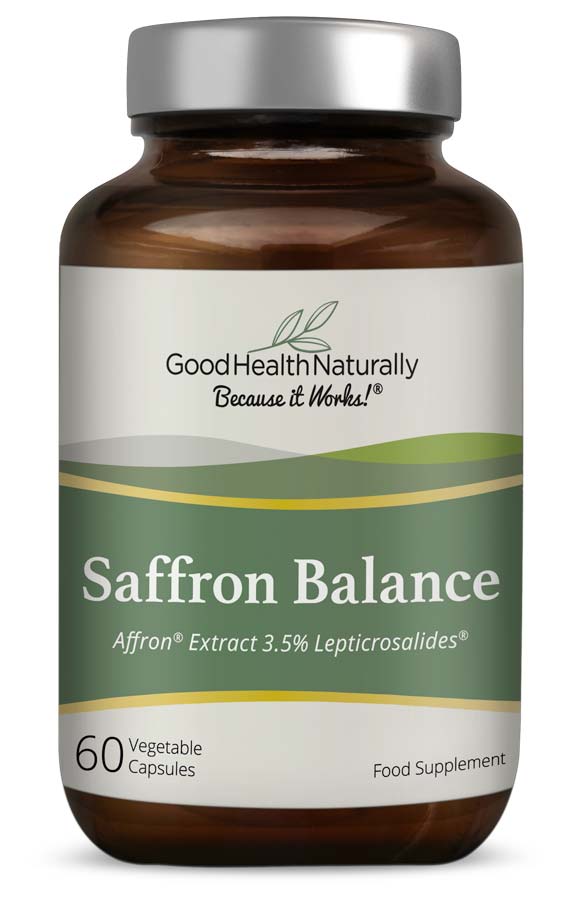
Saffron Balance
Formulated with Affron® saffron extract, Saffron Balance provides a premium, widely researched botanical in an easy daily capsule.